Wind bands in Flanders: An Overture

Harmonieorkest De Pinte - Rondom (c) Viktor Stans
Wind bands such as concert, fanfare and brass bands, known in Flanders as ‘hafabra’, have been part of Flemish music culture for a quarter of a millennium. The musicians, conductors and boards of these wind ensembles make music and have fun together at an intersection of tradition and innovation, in bandstands and on stage, during festivals and competitions. The bands rehearse and perform everywhere, even in the smallest villages, and range in size from a handful of musicians to enormous associations with several ensembles.
Throughout more than two centuries of history, they have been influenced by all kinds of social tendencies and evolutions. Simultaneously, each music association has inscribed its own story within that shared history. This text is an attempt to sketch the common denominator of those stories, thus presenting the sector to those who would like to know more about it. What is hafabra, and where do these ensembles come from? Who plays in them? What music do they perform? How do Flemish wind bands rehearse and play, and how are they organised? And what is their role in the Flemish music scene today?
Ha? Fa? Bra?
Hafabra is an acronym for harmonie, fanfare and brass band. In the Low Countries, it is often used as a collective name for wind bands. The term ‘hafa’ is also heard, more commonly in French-speaking areas. ‘(Wind) bands’ is the English equivalent; in German, they are usually referred to as (Blas)Musikvereine. These terms are linked to the various traditions and instrumentations of such wind ensembles, which are different in each country or region. For example, fanfares are a typical phenomenon in the Benelux countries, and the word ‘fanfare’ has different meanings elsewhere. Conversely, brass bands are a type of ensemble that has been adopted from the United Kingdom. Let’s begin by considering the wind instruments in each of the three ensemble types.
- The harmonieorkest (concert band, wind band or symphonic winds, and referred to here as the ‘concert band’) is the wind ensemble with the largest number of musicians and widest international spread. In concert bands in continental Europe, the clarinets are the basis of the ensemble, as the strings are in the symphonic orchestra. Besides the clarinets, there are flutes, oboes, bassoons and saxophones. At the back of the ensemble are the brass instruments: French horns, trumpets, trombones, euphoniums (or baritone horns) and tubas. A large concert band may have more than 60 musicians and is capable of an impressively wide array of timbres and dynamics, for which many additional instruments may be brought in. Concert bands are the most prevalent type of amateur band in Flanders. The 731 concert bands account for approximately two fifths of the membership numbers of the Flemish Amateur Music Organisation VLAMO, the umbrella organisation for amateur ensembles in Flanders (VLAMO, 2024).
- The fanfare has fewer instruments than the concert band, and the balance in the ensemble is different. The fanfare’s sound is carried by a large group of flugelhorns. It also includes the saxophone family and other brass instruments: French horns, tenor horns, cornets or trumpets, trombones, baritone horns, euphoniums and tubas. In 2020, fanfare culture was added to the Inventory of Intangible Cultural Heritage in Flanders. Flanders currently has 343 fanfares (VLAMO, 2024). To preserve and promote this valuable heritage, VLAMO has launched various initiatives such as a youth fanfare, composition competitions and commissions, additional training for composers and the promotion of the typical instruments (VLAMO, 2022).
Concert and fanfare bands come in all shapes and sizes, from local youth bands to top-level international ensembles. Which instruments they include, and in what numbers, depends greatly on the available musicians. Most bands are constantly searching for members, applying an ‘everyone is welcome’ policy. Melodic instruments such as the flute and trumpet are usually available in abundance; oboes, bassoons, French horns and tenor horns are more difficult to find. Youth ensembles often lack the large, low-pitched instruments that many musicians start playing at a later age.
- Among the three types of hafabra bands, brass bands are the odd one out. They consist entirely of brass instruments, supplemented with percussion. Brass bands have a fixed complement of 25 to 35 musicians (Janssen, 2004; Matthys et al., 2012). The seven to ten cornets sit at the front of the ensemble. They are complemented with flugelhorns, tenor horns, baritone horns, trombones, euphoniums and tubas. The technical flexibility of this selection of brass instruments makes the brass band surprisingly virtuoso. The brass band is by far the most popular form of band in the United Kingdom, and it took until the seventies until it would cross the Channel to Flanders, where there are now a few dozen such ensembles (Matthys et al., 2012).
All hafabra ensembles have extensive percussion, which often plays a more significant role than in the symphonic orchestra (Janssen, 2004). Whereas the complement of brass players in hafabra ensembles has been more or less constant since the 19th century (Parès, 1898), the use of percussion has continued to increase, as it has in the symphonic orchestra, to this day. A contemporary percussion section consists of timpani, a drum kit, cymbals, melodic instruments such as tubular bells, a glockenspiel or xylophone, and many small percussion instruments ranging from the triangle to special effects instruments such as temple blocks or the ocean drum.
The century of wind ensembles
The first large wind groups emerged in France after the French Revolution in 1789 (Matthys et al., 2012). They were enormous military bands that used wind instruments because these could be heard clearly in the open air. Before long, amateur ensembles in Belgium and elsewhere in Europe began to emulate the military bands. They copied the repertoire of military marches, dressed in military-style costumes and marched in formation. Their members came from the bourgeoisie classes, who could devote time and money to this clearly visible and audible expression of their responsible citizenship.
When Belgian society became divided into different pillars at the end of the 19th century (a ‘vertical’ division into Catholic, liberal and socialist, as opposed to the ‘horizontal’ divisions of social class), each pillar established its own wind bands in practically every village (Matthys et al., 2012). Catholic ensembles were generally named after a saint, with the patron saint of music, St Cecilia, in pole position; approximately a fifth of all Flemish wind bands still bear that name (Matthys et al., 2012). The names of socialist ensembles often referred to Progress, Labour or Fraternity; liberal ones to Freedom or Unity. This wide expansion of wind music served two purposes (Dubois et al., 2009): the edification of the people through the encounter with adaptations of highbrow classical music, and the stimulation of citizenship and community building – clearly within one’s own pillar of society first and foremost.
The success of wind music in the nineteenth century would have been unthinkable without the many technical improvements to the instruments. The invention of the valve meant that brass instruments like the trumpet and French horn were no longer limited to a handful of harmonics, but could play all the chromatic notes. For woodwind instruments, new keywork systems enormously improved their playability and potential. The saxophones and saxhorns that the Belgian Adolphe Sax (1814-1894) produced on a large scale from 1843 onwards were especially important to wind music. Based on the model of French mounted bands (fanfares de la cavalerie) which immediately adopted the sax horns (flugelhorns, tenor and baritone horns), the brass band emerged in Great Britain. In the Low Countries, fanfares with saxhorns and saxophones sprang up like mushrooms from 1860 onwards (Matthys et al., 2012).
The heritage of wind ensembles has been widely documented over the past decades (Baeten & Vermote, 1992; Cemper., n.d.; De Bleecker et al., 2007; Withofs et al., 1986). The surviving instruments, banners, uniforms and eye-catching bandstands are silent witnesses today to the more than 3000 wind bands that existed in Belgium before the First World War.

Social changes and the wind band today
After the First World War, however, wind bands gradually faded into the musical background (Matthys et al., 2012). During the war, the occupying forces banned them from rehearsing or giving concerts. The rise of the vinyl record, radio and later the television meant that wind bands were no longer the most important way for the general public to access music. As a leisure activity, furthermore, they faced competition from sport and the cinema. And new forms of popular music emerged throughout the 20th century in the form of American jazz, big band music and rock & roll, which were widely available and appealed more to young people. In the 60s and 70s, nobody would have bet a cent on the future of wind bands. From the 1980s onward, however, there were signs of hope for the sector once again (Matthys et al., 2012). Many wind ensembles set up youth bands, so that young people (and no longer just boys) could grow within the association alongside their peers. At the same time, many of these young people learned to play an instrument in music schools, which were formalised into the rapidly growing part-time art education (dko) academies. The new influx of members brought new ideas, as well as changes in how the ensembles performed.
The original performance contexts for wind bands were open-air activities, often linked to public holidays. Many wind bands have kept up their traditional duties during local festivities, even today. Nevertheless, in comparison to other regions in Europe, the Flemish hafabra scene has evolved strongly away from entertainment at fêtes and festivities, preferring to give autonomous concerts. Their concerts are separate events that they organise themselves, occasionally with other ensembles. Many concerts are held in the auditoria of the cultural centres managed by local authorities. The musicians play in neutral uniforms; unlike elsewhere in Europe, traditional costumes have hardly any meaningful role in Flanders. Where possible, lighting and a digital presentation with atmospheric background images provide a concert experience that meets contemporary standards.
In a society where impeccably recorded and mixed music is omnipresent, the rising level of musical education and the shift to formal stages are also raising the bar for musical proficiency in amateur bands. This can present a challenge to the social blend in an ensemble, for example for members who learned to play their instrument in the association long ago and are unenthusiastic about the growing musical ambitions. Another effect of the concert tradition is that the visibility of the amateur band within its own community has almost disappeared (Matthys et al., 2012). After all, the audience in the concert hall consists mainly of a relatively closed circle of family members, friends and supporters.
(Beyond) wind bands
Besides concert bands, fanfares and brass bands, there are other forms of wind bands in Flanders. For example, Flanders has around fifty wind ensembles that focus on the music and folklore of southeastern Germany, Austria, Czechia and Slovakia. You see them at local festivities in lederhosen and other Central European costumes. They perform in combinations of wind and percussion instruments, often with singers (Matthys et al., 2012; VLAMO, n.d.).
Another phenomenon is the street band, which has emerged since the turn of the century, mainly in urban areas. These bands combine influences from Eastern styles (the Balkan, Arab or klezmer tradition) with Latin-American rhythms and North American jazz or hip hop. Like the more carnivalesque festival or travelling bands (carnaval bands), they create a lively atmosphere and emphasise their Bohemian vibe with theatrical elements or dancers (Matthys et al., 2012). Another eclectic group of amateur ensembles have an emphatically commitment, in which making music serves the goal of social integration or emancipation (Verneert, 2023). These ensembles also exist mainly in urban environments. They often experiment with artistic co-creation between professionals and amateurs, based on democratic decision-making processes. These socio-artistic practices strongly resonate with what is known as ‘community music’ in the English-speaking world (Southcott & De Bruin, 2022).

Although there are almost a hundred Flemish drum and percussion ensembles, these are grouped together with the wind music sector, since they share a history of military music and open-air performances. Diverse as these ensembles are, they consist entirely of percussion instruments. Flanders also has a handful of marching and show corps, which combine wind music in various configurations with choreography and show elements, sometimes in the American tradition, supported by a colour guard, i.e. a group of dancers with military attributes such as flags or weapons (VLAMO, n.d.).
Last but not least, Flanders also has many amateur ensembles rooted in the classical or folk tradition. As such VLAMO has approximately forty string and symphonic orchestras among its members, plus several guitar ensembles, accordion ensembles, bagpipe groups, etc. (VLAMO, n.d.).
Amateur musicians
The Royal Bands of the Belgian Military Forces are Belgium’s three professional wind bands. Most wind bands, however, are amateur ensembles. Although the term ‘amateur’ is used frequently by sector organisations, its use to describe ‘non-professional’ groups is not without controversy. For some, the word has connotations of dilettantism and lower skills; others understand amateurism, derived from the Latin amare, to love, as the strength of those who love to make music (Verneert & Delft, 2024). In practice, moreover, it has become clear that amateur and professional do not need to be opposites. Leading amateur ensembles often have several professional members who earn their living as musicians in other contexts but play in this ensemble for pleasure. Furthermore, professional musicians play various key roles in the sector, as conductors, composers, instrument teachers, band coaches and so on. Conversely, a considerable minority of amateur musicians, whether or not they have a degree in higher musical education or earn a substantial income from music, feel themselves to be semi-professional or professional (Vanherwegen et al., 2009). Many professional Flemish conductors, composers and performers (woodwind and brass players) learned their craft in their association as children.

Thus amateurism mainly means that these ensembles take the form of a serious leisure activity for their members (Stebbins, 1976). In activities of this kind, amateurs practice publicly visible activities that also exist at professional level (Stebbins, 2020). Amateur arts require a substantial investment and perseverance, but offer a path for personal growth, self-actualisation and fulfilment in return. Within an amateur band, a complex and ensemble-specific ethos of social and musical values can emerge, with which the musicians strongly identify. Beliefs concerning the how, who, what and when of making music together, or about the musical and social meanings of the association (and the relationships between them), may therefore vary greatly from band to band.
One of the unique characteristics of amateur bands is that they are intergenerational: younger and older people play together, learning from each other. Nevertheless, age-related subgroups play an important role in social cohesion (Bons et al., 2022a, 2023b; Dubois et al., 2009). The intense interactions within instrumental sections (Dubois et al., 2009) and family relationships also creates social drivers across the generations. This connection with family, friends and acquaintances is usually crucial to new members’ decision to take up an instrument and join the ensemble (Dubois et al., 2009; Vanherwegen et al., 2009). School, music school and concerts are other visible stakeholders that may help push young people in the direction of playing a musical instrument (Vanherwegen et al., 2009).
Until far into the 20th century, amateur bands were almost exclusively a male affair. Among older members and in the governing bodies, male dominance is still very noticeable (VLAMO, 2022). In the younger generations, the feminisation that began a few decades ago is continuing apace. VLAMO now has more female than male members under the age of 26 (VLAMO, 2024). Conducting was traditionally a male profession, but change is also apparent here: a third of the students learning instrumental music conducting in part-time arts education are now female (Department of Education and Training, 2024). However, the choice of instrument is far from gender neutral. Loud or prominent instruments are more often chosen by boys, while soft ones with a supporting role in the ensemble are also chosen by women (Abeles, 2009; Hallam et al., 2008; Sheldon & Price, 2005). Figures in part-time arts education show that woodwind instruments such as the flute, oboe and clarinet are mainly played by women; the saxophone and bassoon are mixed. Men tend to go for brass and percussion, with the exception of the tenor horn, French cornet and flugelhorn, where the distribution is even (Department of Education and Training, 2024).
Repertoire and composers
The historical background and instrumentation of wind bands also imply a repertoire of their own. The traditional band repertoire consists of marching music, adopted from the military predecessors of these bands, supplemented with 19th-century dances such as the polka or waltz. Transcriptions of popular classical pieces, such as overtures and arias from operas and operettas, are another important part of the historical repertoire. Based on the idea of edifying the people, this was a way to introduce highbrow symphonic repertoire to the general public, who did not have season tickets to the opera or concert hall (Dubois & Méon, 2013).
Nevertheless, there has always been a gap between symphonic classical music and wind repertoire. Composers of the symphonic genre seldom wrote for wind instruments, and if they did so, they tended to write for combinations that were nothing like the evolving instrumentations of wind bands. This is why, since the early days of such bands, most of the compositions and arrangements have been written by a separate group of composers, usually people who are active in the sector as conductors.
The first generation of composers for wind ensembles in Belgium consisted of military band leaders such as Jean-Valentin Bender (1801-1873), Henri-Joseph Labory (1843-1882) and Michel-Joseph Steenebruggen (1838-1903) (Matthys et al., 2012). In the decades either side of the turn of the century, Paul Gilson penned around 75 works for wind band (Bertels, 2023). His students, known as the Synthetists, created a repertoire between the wars that was suitable for the Belgian military bands (Vertommen, 2023). Their music brought modernism into wind music, although publishers and musicians in the first half of the 20th century were often unwilling to accept the complex new repertoire (Bruyneel, 2012; Vertommen, 2023). In the course of the 20th century, a distinct style developed out of music inspired by symphonic and military repertoire, which we might refer to as wind music. After the Second World War, this original music made increasing inroads into bands, while the opera transcriptions and arrangements lost their unique selling proposition as an access route to classical music, given that the mass media were now ubiquitous (Bruyneel, 2012). The new compositions made optimal use of the possibilities of the now-standardised wind bands and the ever-increasing quantity of percussion. Wind music exists for all levels of proficiency, from simple arrangements for entry-level ensembles to complex compositions in a challenging musical idiom. Their musical language reveals the legacy of instrumental chorales, military signals and marching music. Many wind compositions today have a programmatic reference that is portrayed filmically in the music. Moreover, a steady flow of new repertoire means that wind bands, in contrast to the symphonic world, tend to concentrate on playing new, contemporary repertoire. Much wind music is published for several instrumentations; you would have a long search to find a composition for the fanfare that has never been adapted for the concert band.

Furthermore, music by composers from the wind bands’ own country and region is granted a prominent place, far more so than in amateur symphonic orchestras. Flanders has many composers of wind music today, and the compositions of many of them are also played internationally. Jan Van der Roost (°1956) is widely known both in Flanders and abroad. Jan Hadermann (°1952) and Piet Swerts (°1960) belong to the same generation. Following in their footsteps are Bert Appermont (°1973), Kevin Houben (°1977), Wouter Lenaerts (°1981), Sven Van Calster (°1981), Filip Ceunen (°1983), Klaas Coulembier (°1984) and Stan Nieuwenhuis (°1985), among others. Upcoming names are Stijn Aertgeerts (°1992) and Tom Hondeghem (°1992). Most composers are also performing musicians, conductors and arrangers themselves, and many of them grew up musically in an amateur band, usually in rural regions in the provinces of Limburg, Antwerp or West Flanders.
We are trying to show content from YouTube.
Kunsten.be only uses minimal cookies. To view content by a third party website, this site can place additional cookies. By continuing to browse you are agreeing to the use of those third party cookies.
Read more about our privacy policy?
Despite the feminisation among members and conductors, this list of composers still strongly reflects the traditional male dominance in the hafabra sector. The concern about a lack of ethnic and cultural diversity in visible positions in the sector is echoed internationally (e.g. Bons, 2025). In the United States, the female composer Julie Giroux (°1961) and the composer with Guyanese roots, Omar Thomas (°1984) are considered to be pioneers of a more diverse landscape of composers. These international developments are relevant to Flanders, where there is plenty of foreign wind music on music stands as well.
The repertoire of amateur bands is usually determined by the conductor, sometimes in consultation with the governing body. Conductors do not only consider the audience’s taste, but also – and above all – that of the musicians. In an amateur band, after all, musicians are not primarily the suppliers but rather the first recipients of musical experiences. They expect a repertoire that delivers exciting, collective musical interactions, suits their level of musical proficiency and more or less corresponds to their musical tastes (Buelens et al., 2024).
Clearly these tastes vary among the musicians within an ensemble (see Bons, 2025, for a summary of research in the German-speaking world). For example, many musicians with a high level of musical training enjoy playing original compositions or classical music. Older members may be more strongly attached to traditional wind repertoire. Adaptations of film music, musicals and pop music seem to be especially popular among young musicians. The opportunity to add one’s ‘own music’ to the repertoire may be an important factor in motivating young people to stay in an ensemble (Bons et al., 2022a). The heterogeneous tastes of musicians thus lead to an eclectic repertoire that shifts effortlessly between classical and pop, film and marching music, and between hit songs and musical tunes (Dubois & Méon, 2013). As such, playing in an amateur band still broadens the musical horizons of the players today, just as it did when these ensembles began 200 years ago. The frown on a few old grandads’ faces as they pump the disco basses from the Lady Gaga Hit Mix out of their tubas is all part of the fun.Aside from most traditional scores, the music and scores of the entire wind repertoire are subject to copyright, so it cannot simply be adapted and published. Moreover, writing band arrangements is particularly time-consuming. By acquiring rights and recruiting writers, publishers such as Hal Leonard/De Haske, Belwin, Alfred, Molenaar and various other, smaller publishers play a key role in the choice of repertoire. Publishers usually classify the repertoire for these bands into difficulty levels from one to six, roughly corresponding to the competition categories described below. In fact, these categories are mainly based on the degrees of proficiency and curriculums of the thousands of school bands in North America (Lee & Worthy, 2012), where music lessons in secondary schools usually take the form of singing in a choir or playing in a band. So clashes do happen between the interests of big, American publishers and Flemish composers (see also Geudens & De Baets, 2025). For example, fanfares have little visibility outside Flanders and the Netherlands, and as such publishers are less interested in music written for this type of ensemble. Internationally, after all, the chances of a concert band arrangement of the same piece being performed are much greater. Flemish publishers such as Ypress, Minor Scale, ADM Scores, Golden River Music or BVT Music therefore play an important role in the ecosystem, although the collaboration with Dutch and other (smaller) publishers in the neighbouring countries should not be underestimated.
How does wind music work?
In band music, all the instruments (or groups of instruments) have their own musical possibilities. In the simplest arrangements, differences in timbre between instruments have limited meaning, if any, and the musical roles are mainly distributed by pitch. So the bass line is for low instruments like the tuba, baritone saxophone or bass trombone. The highest wind instruments play the melody. The other instruments play parallel lines in between, with the same rhythm but a different pitch that fits into the chord, or accompanying elements such as long notes, offbeats and short, rhythmic motifs, often with several voices in a chord.
In ensembles with a higher proficiency level, and often with a more varied range of instruments, the arranger designates various ‘choirs’ within the ensemble. The most extensive group of instruments carries the music: ‘soft’ brass instruments (cornets, saxhorns and tubas) in brass bands and fanfares, and single reeds (clarinets and saxophones) in concert bands. The ‘hard’ brass (trumpet and trombone) and woodwind instruments (flute, oboe and bassoon) offer contrasting timbres. The secret of good arrangers is that they can add variation to the homogeneous sound and limited range of the many brass instruments in these bands. To do so, they make extensive use of different kinds of mutes for the brass instruments, as well as percussion effects.
With occasional exceptions, a wind band is made up of sections comprising several musicians who play the same instrument. Two to four different parts are provided for many sections. There are regularly also several players per part, especially in the largest instrument group that underpins the ensemble. Within the parts for a single instrument, there is a clearly descending level of difficulty: the first part may contain solos and the highest (and so the most physically challenging) notes, but the second and subsequent parts are lower and less prominent (Janssen, 2004). In this way, the arrangement offers the opportunity to differentiate between musicians with varying degrees of proficiency (Buelens et al., 2024).
In concert bands and fanfares, the number of players per part is relatively flexible and depends on the number of musicians available. The arrangements provide for a certain amount of flexibility with duplicate parts, cues, or optional parts for unusual instruments such as the alto clarinet or fourth horn part, ensuring that these are not essential to perform the piece satisfactorily (Janssen, 2004). In this way, bands with different instrumentation can all work with the same arrangement. The higher the level, the more a standardised and complete instrumentation is expected. The conductor has a score on which all the parts are notated one under another. Musicians only see their own part and have to play along with the other parts by ear and in coordination with the conductor. This makes it essential to be able to read music well.
Rehearsals and conductors
To understand amateur ensembles properly, we must realise that most of the time they spend making music is not during concerts, but in rehearsals. It is not the concert stage but the rehearsal room, rehearsal process and the activities before and after rehearsals that form the heart of the association (Buelens et al., 2024). Musicians experience comradeship and sociability in the band, which is part of the reason for their commitment (Laurisch, 2018). Playing in an amateur band is something musicians do for both social and musical reasons, and each musician has their own balance between the two (Bons, 2025). The recipe for a successful amateur band seems to be located in the combination of musical and social goals. The concept of togetherness (Miteinander, see Bons, 2025; togetherness, see Keller, 2014) is sometimes used for this. The Australian psychologist Peter E. Keller describes this as the pleasant, intrinsically rewarding experience of being in social synchrony with others […] through affective-motor resonance ( Bishop & Keller, 2022).
Responding to this combination of musical, social and clearly also personal goals is an important skill for the conductor of an amateur band. Increasingly, conductors are qualified professionals, with a bachelor’s or master’s degree earned in one of the several Flemish programmes for wind band conductors. A growing number of part-time arts academies offer training for instrumental conductors, a programme from which a few dozen amateur conductors are already graduating each year (Department of Education, 2024). Almost all amateur bands have a permanent conductor, who often stays with the ensemble for many years. If there are several ensembles, such as a youth or percussion group, associations often work with several conductors.
The role of conductors involves a lot more than making a lively musical interpretation of the score, in dialogue with the band, during a performance. They also have an important role as an educator. Usually, they are the most highly trained musician in the group and use that expertise to keep the rehearsal on track, indicating how the music is to be played. Sometimes, conductors adapt a part so that it is better suited to the musician’s skill level. Conductors usually take the time to let groups of instruments play separately, repeat difficult passages and get to grips with them together. As well as practicing together at rehearsals, musicians may also practice individually outside rehearsal times. The need for extra practice at home varies greatly between musicians, due to the range of playing abilities. The expectation that musicians will practice is open at many ensembles: it is often encouraged but seldom obligatory.
Organisation and community
Almost all amateur bands are non-profit organisations, supported by a governing board of volunteers who determine the composition of the board themselves. The governors keep the association going by means of their personal network and close contacts with local governments (Dubois et al., 2009). Local councils often play a supporting role by making premises or sheet music available. Sievers (2018) highlights the importance of ‘local heroes’, key figures who participate in many associations. This voluntary commitment can be traced back to the social ideal of an independent, committed citizen during the Enlightenment, the period when these bands emerged. Today, this type of commitment is under pressure from the increasing possibilities and expectations of an accelerating, individualised society. Both bands and their governing boards are finding that commitment to an association is more individual, temporary and noncommittal than it used to be (see also Bons, 2025).
Financial grants from regional and local governments have been decreasing in recent years, both in Flanders and the surrounding regions. Fortunately, many bands are self-sufficient thanks to income from concerts. Musical leadership is a significant expense. The conductor can be paid as a freelancer or by means of specific payment schemes for the amateur arts. A standard remuneration rate for conductors, as recently proposed by the Flemish Conductors Guild (2024), does not yet apply in Flanders. Many wind bands also invest in percussion instruments, and sometimes in instruments to be lent out to musicians (especially beginners). All of this is financed with income from events, and sometimes musicians also pay a limited membership fee. Most amateur bands organise their own concerts several times a year. Other typical activities are concert tours, dinners, and of course festivals and competitions.
Competitions and meet-ups
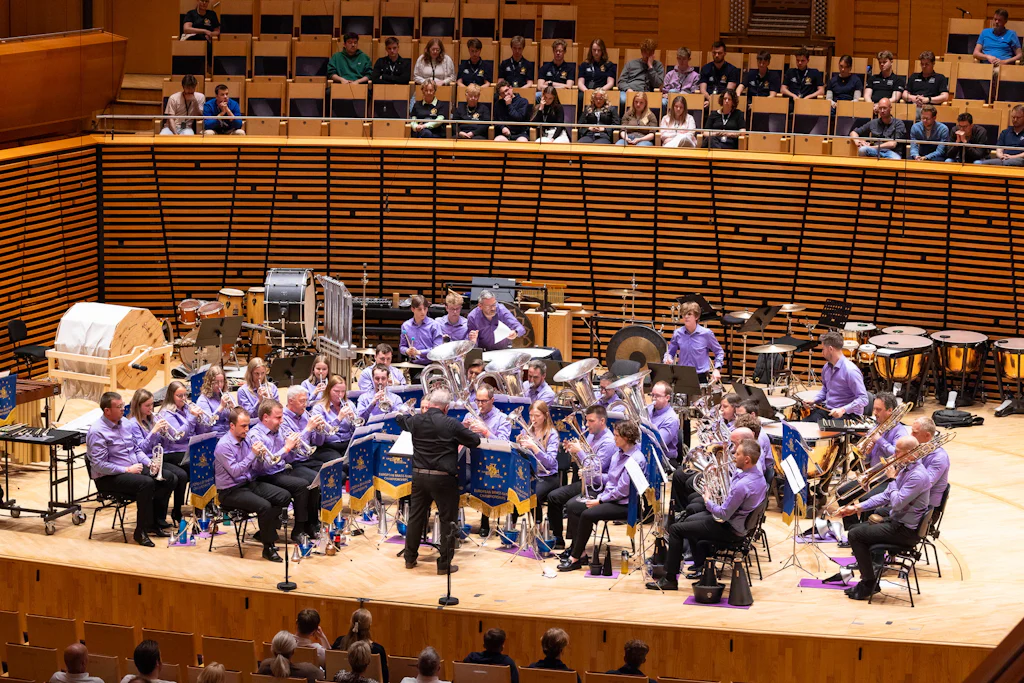
The tradition of competitions in wind music dates back to the mid-19th century and exists for both ensembles and soloists (Matthys et al., 2012). Federations in the sector organise these competitions to encourage ensembles to gradually improve their musical level (VLAMO, 2022). The Flemish open concert band and fanfare championships are usually fought out between a few dozen ensembles in six categories (third, second and first class, followed by the categories excellent, honour and superior). During such competitions, bands receive feedback from a jury of experienced conductors and are also ranked. Especially in the highest categories, competitions are regularly a matter of honour. Ambitious ensembles sometimes also participate in the international competition circuit, with the European Championship for Wind Orchestras (ECWO), the European Brass Band Championship (EBBC), the World Music Contest (WMC) every four years in Kerkrade in the Netherlands and the Certamén Internacional de Bandas de Música in Valencia, Spain as the highlights. We find the most competitive spirits of all in the world of brass bands (Matthys et al., 2012). At least half of Flemish brass bands compete in the Flemish championship every year, which is far more than in the other disciplines. Leading Belgian brass bands such as Brassband Willebroek or the Noordlimburgse Brassband are among the best in Europe.
Flemish amateur bands are united by the Vlaamse Amateurmuziekorganisatie (Flemish Amateur Music Organisation, VLAMO). This umbrella organisation offers the bands support and services, organises meet-ups, offers coaching by experts, collects sheet music and has a branch in each province and for each type of ensemble.
Until 2017, participation in the competitions organised by the Flemish provinces was a necessary condition for eligibility for annual provincial subsidies. This funding channel no longer exists, and consequently participation in the competitions has dropped sharply. In recent years, VLAMO has been rejuvenating the traditional culture of competitions with initiatives such as evaluation concerts or festivals (VLAMO, 2022). Bands can work towards these occasions and receive feedback from a professional jury without subjecting themselves to the stresses and strains of a competition. In the new amateur arts decree (Flemish Parliament, 2024), bands that are aiming for national level or want to participate in international activities can apply for grants on a project basis. This means that financial support is no longer widely distributed, instead focusing mainly on ensembles that excel.
Hidden gems in rural areas
Amateur bands are local associations linked to the town or village where their rehearsal room is located and the immediate or wider surrounding area. Because they were established even in the smallest villages in the second half of the 19th century, the hafabra sector today is still particularly strong in the countryside. Today’s leading Flemish concert bands, fanfares and brass bands are also mainly located in rural areas (VLAMO, n.d.). Alongside the music school, amateur ensembles are the bearers of local music culture. Nevertheless, it would be mistaken to understand amateur bands entirely as a parochial affair. After all, many of them are active over a wider area and recruit musicians from the entire region (Geudens & Scheltjens, 2024). In densely populated Flanders, many towns and villages flow into each other, meaning that notions such as ‘local’ or ‘rural’ are best taken with a grain of salt.
However, wind bands do offer a counterweight to the idea that the countryside is culturally disadvantaged by definition. In recent years, the idea has been growing that forms of rural and folk art should be appreciated on their own terms, rather than merely as a substitute for art in areas where the ‘highbrow’ music culture of concert halls, opera houses and symphonic orchestras is absent (Bons, 2025). Likewise, on a larger scale, we are witnessing an increased visibility of the regional cultures of rural regions such as Limburg, the Kempen (Province of Antwerp) or West Flanders in Flemish popular culture. Take the many television series in local dialects, or the countless pop singers who sing in their own dialect. We still have to wait and see how much the amateur arts sector will be able to benefit from this wave of appreciation for rural culture.
Wind bands certainly have plenty of work to do in terms of their public relations with the general public (see also VLAMO, 2022). The sector is struggling, to a great extent undeservedly, with an old-fashioned image of elderly musicians in dusty uniforms playing old tunes at deserted village fêtes. The associations with poor-quality music (‘oompah bands’) and heavy drinking (‘empty glass, silent brass’) are stubborn. Like all clichés, these ones do contain a grain of truth, of course: traditional repertoire, local events and social activities that might involve a drink or two are simply part of hafabra culture. However those who know anything about the sector will surely have seen its rejuvenation, feminisation and innovation, and noted how seriously it is taken. Making this wind of change visible to society at large is a significant challenge for the associations and the umbrella organisation VLAMO (VLAMO, 2022).
Increasing musical proficiency is an important instigator behind all this, and music schools have a significant role here. Some wind bands offer their own instrument lessons, but four fifths of Flemish amateur band members have taken instrument lessons in music schools in the past, or are still doing so (OP/TIL, 2020). Since 2014, music schools have regularly outsourced their ensemble lessons to amateur bands through the alternative learning contexts system (Geudens & Scheltjens, 2024). That means that students take instrument lessons at music school and practice making music in a group by playing in their own ensemble. This system has meant that the competition for the same young musicians that previously existed between music schools and ensembles has often evolved into a more fruitful, co-operative relationship (Geudens & Buelens, 2025).
By working together, music schools and amateur bands challenge each other’s perspectives . Amateur bands are highly invested in organising their musical activities according to their own implicit standards and therefore prefer to keep their distance from formal music schools and evaluation requirements (Bons et al., 2022b; Geudens & Buelens, 2025). Conversely, music schools and policymakers do sometimes take an ignorant or condescending attitude towards amateur bands (Bolliou, 2018). Additionally, there is also artistic criticism that these ensembles’ repertoire is tailored too greatly to the musicians, with too little attention to authentic expressiveness (e.g. Janssen, 2004). So it seems that wind music is stuck in its own bubble between the ‘highbrow’ culture of cultural centres and conservatoires and the popular culture of musicals and pop bands, receiving little acknowledgement from either (Matthys et al., 2012). The French sociologist Vincent Dubois and his colleagues (2009) describe wind music as an aesthetic autarky: a closed system that presents itself as impenetrable to societal judgement. It is true that the musical culture in an amateur band is very much focused on itself (Bildhauer, 2018; Dubois & Méon, 2013). Simultaneously, though, a movement is gradually becoming apparent of bands who are emphatically seeking contact with the community again, through open-air performances, festivals and other innovative concert formats. VLAMO provides project grants to support this open-air tradition, as well as the attraction of new target groups and collaborations with music schools (VLAMO, n.d.).
The sector itself sees the limits it is facing. Their score-based and conductor-centred tradition makes bands less flexible when it comes to integrating inclusion into their practice. Even with good will, it is not always easy to attract musicians with a different cultural and ethnic background, and not always clear what the best ways are to do so (Demyttenaere, 2020). The same applies to other forms of diversity, such as income levels or physical disabilities and health conditions. To support inclusion, VLAMO has been committing actively to a wider connection to society in the last few years (VLAMO, n.d.), in the hope of opening up wind music to other segments of the population (besides well-off healthy white people).
However, we should not forget that there are also many opportunities available to the sector. Collaborations with other social or artistic organisations may completely open up the range of musicians or creators involved. Wind bands have also been using the flexibility of their repertoire as an asset for a broader approach for decades: just as pop, musical and film music have helped to spark the rejuvenation of the sector since the 1970s, a wider choice of repertoire and new arrangements and compositions can probably also appeal to new target groups.
Neither is wind music a stranger to intercultural exchanges. The long-standing military marches have their origins in Ottoman music, and much of the percussion found at the back of the rehearsal room comes from all over the world. The repertoire of fanfares and concert bands in particular is flexible: there is music with familiar elements for anyone who wants to join in, as well as space for more complex arrangements and compositions.
Homegrown
Correspondingly, there is plenty of activity in terms of new music and composers in the field. The Flemish conservatoires all offer programmes to support composers in developing their own artistic practice, and the wind band sector is an enthusiastic recipient of this new music. Composers are often invited to write for celebrations, anniversaries, competitions and concerts with specific themes: this has given young composers such as Lennert Van Laenen and Kobe Janssens the opportunity to find their own voice. While the sector remains loyal to familiar names such as Bert Appermont, Kevin Houben and Jan Van der Roost, newcomers like Els De Saedeleer, Peter Knockaert, Wouter Lenaerts and Jasmien Vandewalle are appearing increasingly often at home and abroad.
Almost all the composers who write for these bands also have a history as band performers. In other words, there are few composers from outside the sector, which is not to say that they do not exist. Pimpanit Karoonyavanich got to know the wind band through her conducting lessons with Jan Van der Roost. In 2017, her composition A Journey to the Bermuda Triangle was nominated for various prizes, and since then she has written actively for the brass band and concert band. Professional wind bands also often attract other composers. Jacqueline Fontyn wrote many works for the Royal Symphonic Band of the Belgian Guides in her own typical idiom.
For other composers, the wind band is a one-off or exceptional activity as part of a participative project in which professional and non-professional musicians engage in a shared project, or as an experiment. For example, Serge Verstockt composed Ein Marsch – Kein Marsch in 2010, and Stefan Prins wrote Plug ‘n Play for Champ d’Action & De Scheldezonen, in a series of participative concerts at De Singel. In collaborations with composers from the contemporary music scene, moreover, wind bands make themselves heard in the country’s major arts centres. In 2018, Frederik Neyrinck composed a piece for Concertgebouw based on the Missa de Sancto Donatiano by the Renaissance composer Jacob Obrecht, for musicians including Ostend’s Koninklijke Stadsharmonie and the Koninklijke Harmonie Sint-Cecilia from Oedelem. This inspired Neyrinck to compose the piece Odolhem as well in 2020, for the 180th anniversary of the Oedelem concert band.
There is also increasing innovation from the field itself. Many composers who focus on wind music play with the tradition and explore its limits. Stan Nieuwenhuis, for example, experiments with the combination of various forms of band and extensive live electronics. Klaas Coulembier actively seeks out challenging rhythms, metric modulations and irrational time signatures with the musicians. This deepening of the standard composition techniques is a welcome variation. Its discovery in dialogue with the band itself engages the musicians, conductor and composer in different ways each time.
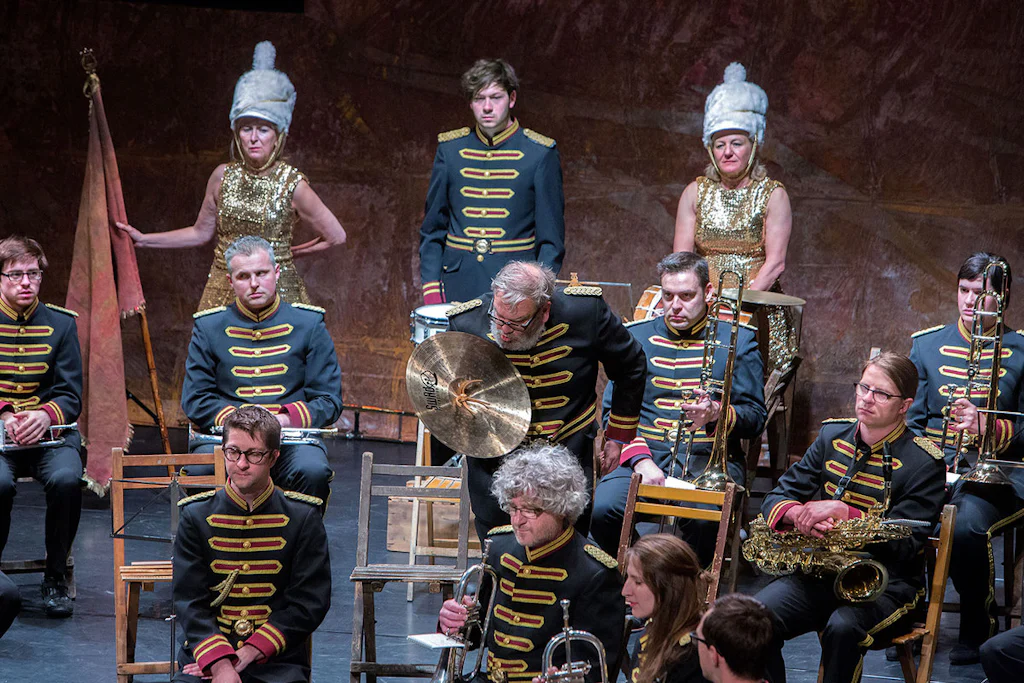
The bands’ engagement is also revealed in ways outside the music itself. These range from adventurous concert formats such as Rondom by the Harmonieorkest De Pinte, in which the audience is surrounded by the musicians, to festival formats such as Blaasfiesta (Harmonie Ypriana) to collaborations with pop musicians such as Brassband de Kempenzonen at the Pukkelpop festival with Daan, Mauro Pawlowski, Sennek and Willy Sommers, to socially committed projects like MARS UVRM by Fanfare Toeterdonk, where the band took over the streets of Leuven in 2022 alongside the participatory art organisations KNEPH and Atelier BLEND to draw attention to universal human rights. VLAMO also rewards projects of this kind with the VLAMO Award (VLAMO, n.d.).

Living music as a key to the future
The future of wind ensembles in Flanders seems both promising and challenging. Despite dwindling grants, the sector’s most significant vulnerability is not financial but human resources. Attracting members is an important attention point. A considerable number of bands struggle with ageing membership, and both in Belgium and abroad, there are signs that it is difficult to attract and retain young people and young adults in the band (Adams, 2019; Bons, 2025; Dubois et al., 2009; Hendriks & Bisschop Boele, 2014; VLAMO, 2022). Although this decline is limited in Flanders, it is still tangible (VLAMO, 2024). The membership of many amateur bands is– unintentionally – very homogeneous due to shared habitus (Bons et al., 2022a). A key question, therefore, is how the sector can open up more to reach groups beyond the customary ones. Initiatives such as offering group lessons in daytime education (such as wind classes, see Bons et al., 2023a), following the example of English-speaking countries, have not yet become widespread in Flanders. Recruiting older people who are learning to play an instrument later in life, or ethnic minority members, seems to be an interesting way of attracting new potential members (Laurisch, 2018).
Appealing to new target groups requires reflection on cultural appeal and accessibility. As described above, the limited cultural capital (Bourdieu, 1983) of amateur bands presents a serious challenge. Their future seems to depend on how they can preserve their separate cultural field and be appreciated within society for doing so, whilst simultaneously adapting to cultural evolutions in that same society (Dubois et al., 2009). Bands need to be valued by society in ways that go beyond recognition as heritage, as though today’s bands were doing nothing but rehashing a legacy. After all, the large quantity of new music, and the sector’s enthusiasm and innovation, paint a very different picture. Finally, social debate should not be limited to the societal meanings of associations and their members, but also include the meaning of playing music in itself. Bons (2025) warns amateur bands against making gratuitous claims of solidarity, democracy or inclusion to make themselves visible to political agendas. Nonetheless, the social value of amateur bands cannot be denied: in contrast to the individualism, speed and compartmentalisation of today’s world, they offer collective experiences and an active love of music. That music, rehearsed and performed every week, is the very heart of the amateur band. Their vibrantly alive musical practices show hafabra great significance to Flanders’ artistic landscape, both today and in the future.
- Author Thomas Geudens – LUCA School of Arts, Geassocieerde Faculteit Kunsten, KU Leuven
- Editorial Partners MATRIX New Music and VLAMO
- Many thanks to Bert Appermont, Ward Bosmans, Klaas Coulembier, Thomas De Baets, Bram Lamberts, Wiebe Sieds Koopal and Jan Matthys
Go to our arts data base for a list of composers and concert bands
References
Abeles, H. (2009). Are musical instrument gender associations changing? Journal of Research in Music Education, 57(2), 127–139. https://doi.org/10.1177/0022429409335878
Adams, T. (2019). Blaasmuziek: Verleden, heden, toekomst. Cultuur+Educatie, 18(53), 38–47.
Baeten, C., & Vermote, G. (1992). Harmonies, Fanfares en Brassband in de Provincie Antwerpen. Snoeck-Ducaju & Zoon.
Bertels, K. (Ed.). (2023). Paul Gilson: Een Brusselse componist van de wereld. Academic and Scientific Publishers.
Bildhauer, J. (2018). Das regionale Netzwerk für Kulturelle Bildung auf der Schwäbischen Alb. https://doi.org/10.25529/92552.20
Bishop, L., & Keller, P. E. (2022). Instrumental ensembles. In G. E. McPherson (Ed.), The Oxford Handbook of Music Performance (Vol. 2, pp. 417–441). Oxford University Press. https://doi.org/10.1093/oxfordhb/9780190058869.013.21
Bolliou, M. (2018). Collaboration Partnerships between Part-Time Arts Education and Amateur Arts [Unpublished Master’s Thesis]. Vrije Universiteit Brussel.
Bons, V. (2025). Der Musikverein als musikalisch-sozialer Erfahrungsraum: Eine Rekonstruktion des handlungsleitenden Wissens Jüngerer Blasmusikvereinsmitglieder. Waxmann.
Bons, V., Borchert, J., Buchborn, T., & Lessing, W. (2022a). Doing Music: Musikvereine and their Concept(s) of Community. In T. Buchborn, T. De Baets, G. Brunner, & S. Schmid (Eds.), Music is What People Do (pp. 245–260). Helbling. https://doi.org/10.25656/01:30479
Bons, V., Borchert, J., Buchborn, T., & Lessing, W. (2022b). Wie verorten Mitglieder von Musikvereinen ihre Arbeit in Abgrenzung zur Praxis von Musikschulen? Eine dokumentarische Studie zu Musikvereinen im ländlichen Raum. In N. Kolleck, M. Büdel, & J. Nolting (Eds.), Forschung zu kultureller Bildung in ländlichen Räumen. Methoden, Theorien und erste Befunde (pp. 349–369). Beltz/Juventa.
Bons, V., Borchert, J., Buchborn, T., & Lessing, W. (2023a). ‘Traumhafte Vorstellung’ oder ‘totale Kataschtrophe’? Perspektiven von Musikvereinen auf Kooperationsbeziehungen in Bläserklassenprojekten. In M. Göllner, J. Honnens, V. Krupp, L. Oravec, & S. Schmid (Eds.), 44. Jahresband des Arbeitskreises Musikpädagogische Forschung (pp. 269–285). Waxmann. https://doi.org/10.31244/9783830997641.16
Bons, V., Borchert, J., Buchborn, T., & Lessing, W. (2023b). Wie kann kulturelle Bildung generationsübergreifende Begegnungen im ländlichen Raum ermöglichen und fördern? In N. Kolleck & L. Fischer (Eds.), Kulturelle Bildung in ländlichen Räumen: Transfer, Ko-Konstruktion und Interaktion zwischen Wissenschaft und Praxis (pp. 213–226). Verlag Barbara Budrich.
Bourdieu, P. (1983). Ökonomisches Kapital, kulturelles Kapital, soziales Kapital. In R. Kreckel (Ed.), Soziale Ungleichheiten (pp. 183–196). Otto Schwartz & Co.
Bruyneel, E. (2020). Variaties op een thema: Van “overschrijvingen” tot originele blaasmuziek. In E. Bruyneel, R. Herreman, A. Stynen & S. Vos, Veel volk verwacht: populaire muziekcultuur in Vlaams-Brabant sinds 1800 (pp. 188-199). Peeters.
Buelens, L., Geudens, T., Vlieghe, J., & De Baets, T. (2024). Naar een (on)pedagogiek van het amateurorkest? Cultuur+Educatie, 23(66), 103–116.
Cemper. (n.d.). Themadossier hafabra. Retrieved 27 October 2024, from https://cemper.be/themas/hafabra
De Bleecker, M., Devos, W., & Collignon, J. (2007). Hoor! De muzikanten! Van ‘Amicitia’ tot ‘Willen is Kunnen’: Harmonie, fanfare, symfonie, brassband, big band… In Oost-Vlaanderen—18e/20e eeuw.
Departement of Ecucation. (2024). Dataloep: Inschrijvingen deeltijds kunstonderwijs. https://onderwijs.vlaanderen.be/nl/onderwijsstatistieken/
Demyttenaere, B. (2020). In harmonie: De kracht van het middenveld. Mammoet.
Dubois, V., & Méon, J.-M. (2013). The Social Conditions of Cultural Domination: Field, Sub-Field and Local Spaces of Wind Music in France. Cultural Sociology, 7(2), 127–144. https://doi.org/10.1177/1749975512473748
Dubois, V., Méon, J.-M., & Pierru, E. (2009). Les mondes de l’harmonie: Enquête sur une pratique musicale en amateur. La dispute.
Flemish Conductors Guild. (2024). Adviestarieven dirigenten.
Flemish Parliament. (2024). Amateurkunstendecreet van 8 maart 2024. https://codex.vlaanderen.be/Zoeken/Document.aspx?DID=1039589¶m=inhoud
Geudens, T., & Buelens, L. (2025). Amateur Ensembles as ‘Alternative Learning Contexts’ for Music Schools in Flanders. In V. Bons, J. Borchert, T. Buchborn, & W. Lessing (Eds.), Land – Musik – Verein: Musikvereine in Praxis und Wissenschaft. Hochschule für Musik Freiburg.
Geudens, T., & De Baets, T. (2025). ‘Write for the Trombonists, not for the Trombones’: The FACETS Framework for Performer-Oriented Orchestration in Amateur or Student Bands and Orchestras.
Geudens, T., & Scheltjens, E. (2024). Deeltijds kunstonderwijs en amateurkunsten: Een ecosysteem van muziekparticipatie. In T. De Baets, M. Magerman, & N. Vansieleghem (Eds.), Compos(t)eren: Schetsen van kunst en educatie (pp. 243–258). Owl Press.
Hallam, S., Rogers, L., & Creech, A. (2008). Gender Differences in Musical Instrument Choice. International Journal of Music Education, 26(1), 7–19. https://doi.org/10.1177/0255761407085646
Hendriks, L. H., & Bisschop Boele, E. H. (2014). Orkesten onder druk? Op zoek naar trends en ontwikkelingen in de HaFaBra-sector in Noord-Nederland. Kenniscentrum Kunst & Samenleving, Hanzehogeschool Groningen.
Janssen, H. (2004). Handboek instrumenteren voor blaasorkest. Muziekgroep Nederland.
Keller, P. (2014). Ensemble Performance: Interpersonal Alignment of Musical Expression. In D. Fabian, R. Timmers, & E. Schubert (Eds.), Expressiveness in Music Performance (pp. 260–282). Oxford University Press. https://doi.org/10.1093/acprof:oso/9780199659647.003.0015
Laurisch, M. (2018). Das Klingen abseits urbaner Zentren: Wie Musikvereine ihre ländlichen Räume prägen und gestalten. Kulturelle Bildung Online. https://doi.org/10.25529/92552.12
Lee, W. R., & Worthy, M. D. (2012). North American School Ensembles. In G. E. McPherson & G. F. Welch (Eds.), The Oxford Handbook of Music Education (Vol. 1, pp. 806–825). Oxford University Press. https://doi.org/10.1093/oxfordhb/9780199730810.013.0049
Matthys, J., Delodder, H., Libert, M., & Vanfleteren, S. (2012). En avant, marche! Over majorettes, harmonies, fanfares en andere blaasorkesten. Hannibal.
OP/TIL. (2020). Dit doet me wat: Amateurkunsten in Vlaanderen.
Sheldon, D., & Price, H. (2005). Sex and Instrumentation Distribution in an International Cross-Section of Wind and Percussion Ensembles. Bulletin of the Council for Research in Music Education, 2004(163), 43–52. https://doi.org/10.2307/40311594
Sievers, N. (2018). Kulturpolitik für ländliche Räume. Kulturelle Bildung Online. https://doi.org/10.25529/92552.11
Southcott, J., & De Bruin, L. (2022). Musical Ecologies: Instrumental Music Ensembles Around the World (1st ed.). Routledge. https://doi.org/10.4324/9781003254508
Stebbins, R. A. (1976). Music Among Friends: The Social Networks of Amateur Musicians. International Review of Sociology (Series II), 12, 52–73.
Stebbins, R. A. (2020). Introduction to the Serious Leisure Perspective. Springer. https://doi.org/10.1007/978-3-030-48036-3_1
Vanherwegen, D., Lievens, J., Vangoidsenhoven, G., Siongers, J., Smits, W., & Elchardus, M. (2009). De amateurkunsten in beeld gebracht: De ledenbevraging van VLAMO. Forum voor Amateurkunsten.
Verneert, F. (2023). Throw Them in the Deep End: The Potential Oo Musical Improvisation in Connecting Participatory Music Activities and Formal Music Education [Unpublished doctoral dissertation]. LUCA School of Arts, Associated Faculty of the Arts, KU Leuven.
Verneert, F., & Delft, B. (2024). Amateurkunsten en kunsteducatie: Over begrip en perceptie. In T. De Baets, M. Magerman, & N. Vansieleghem (Eds.), Compos(t)eren: Schetsen van kunst en educatie (pp. 223–240). Owl Press.
Vertommen, L. (2023). Paul Gilson en les Synthétistes: Context en muzikaal modernisme in het repertoire voor harmonieorkest van Paul Gilson en les Synthétistes tijdens het fin de siècle en het interbellum in Brussel. Vrije Universiteit Brussel.
VLAMO. (n.d.). Vlaamse Amateurmuziekorganisatie. Retrieved 26 November 2024, from https://www.vlamo.be
VLAMO. (2022). Beleidsplan 2022-2026. VLAMO.
VLAMO. (2024). Voortgangsrapport 2023-2024. VLAMO.
Withofs, M., Langie, E., & Vansummeren, P. (1986). Harmonies en fanfares in Limburg. Gemeentekrediet Brussel.